
Contact Lens Storage Instructions for Private Label Brands
Quick answer: A storage instruction on a contact lens pack is a regulatory artifact, not a marketing line. For private label contact lenses the pack is also the brand's only legal voice — the factory's name is on it, but the statement is yours. Before artwork is approved, a private label brand needs four things locked: a storage statement that matches the product's validated conditions, a shelf life supported by stability data rather than assumption, an IFU that tells the wearer exactly how to clean, store and replace the lens, and claims language that survives a regulator's reading — most commonly "FDA-registered facility", never "FDA-certified". Everything else on the carton is design. These four are exposure.
Brand owners come to us with a finished design and an unfinished regulatory file. The design usually takes a week; the wording, the shelf-life justification and the market-by-market registration take considerably longer — and they are the part that decides whether the product can be sold at all. This is a working checklist for that part.
Why the storage statement is a regulatory document
Contact lenses are regulated medical devices in every major market. That has a specific consequence for packaging: for private label contact lenses, the label and instructions for use are part of the device's technical documentation, and a mismatch between what the pack says and what the validated data supports is a non-conformity — not a typo.
For the wearer, the storage statement answers four questions: how to keep the lens before opening, how to keep it between wears, how long it may be stored before re-disinfection, and when to stop using it. For a regulator, it is the evidence that you understood your own product.
Three failure modes recur across private label launches:
- Copied wording. Storage text lifted from a competitor's carton describes a different lens, a different blister and a different validated shelf life.
- Generic claims. "Store in a cool, dry place" is not wrong, but it does not tell anyone what to do, and it does not defend a shelf-life claim.
- Orphan statements. The IFU says one thing, the carton says another, and the website says a third. Whichever a regulator reads first becomes the version you have to defend.
Four things to lock before artwork
1. The storage statement
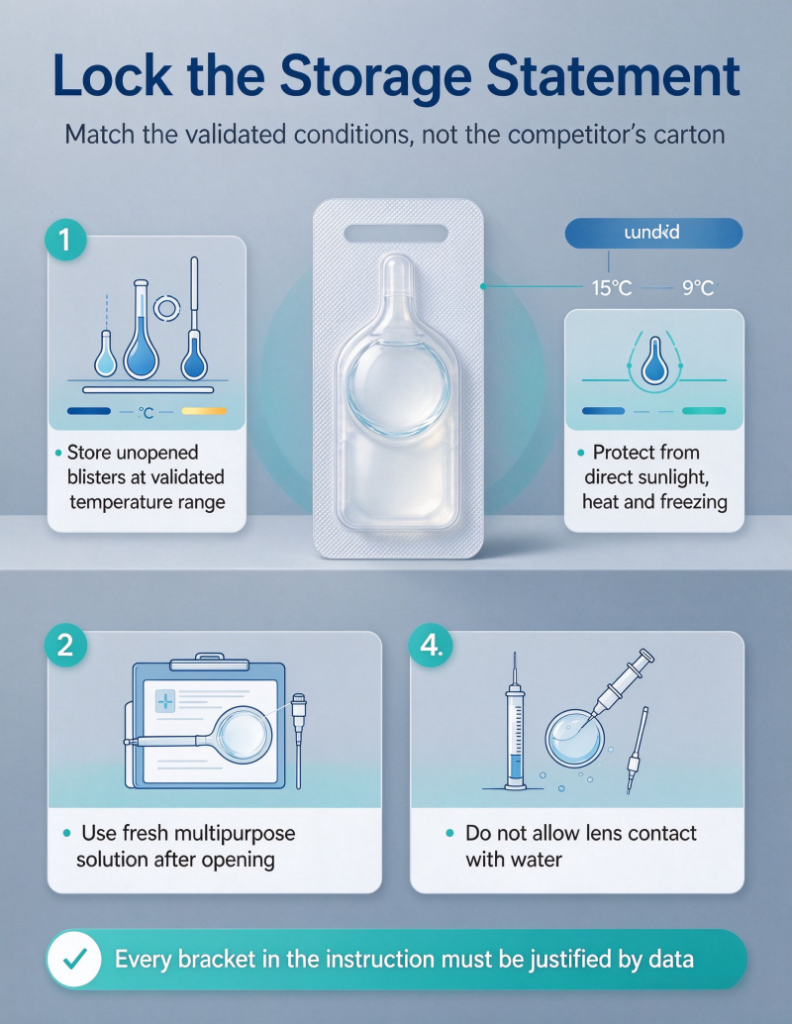
It must reflect the product's real validated conditions and be understandable by a non-specialist. A workable structure, to be adapted to your technical file:
Store unopened blisters at [validated temperature range], away from direct sunlight, heat sources and freezing. Do not use if the foil seal is damaged. After opening, store the lens in fresh multi-purpose solution in a clean lens case; replace the solution at every storage. Do not allow the lens to contact water. Replace the case at least every three months. Replace the lens according to the wearing schedule in this leaflet.
Every bracket is a decision you must be able to justify. If your stability protocol did not test a temperature range, you cannot print one.
2. Shelf life, and who owns it
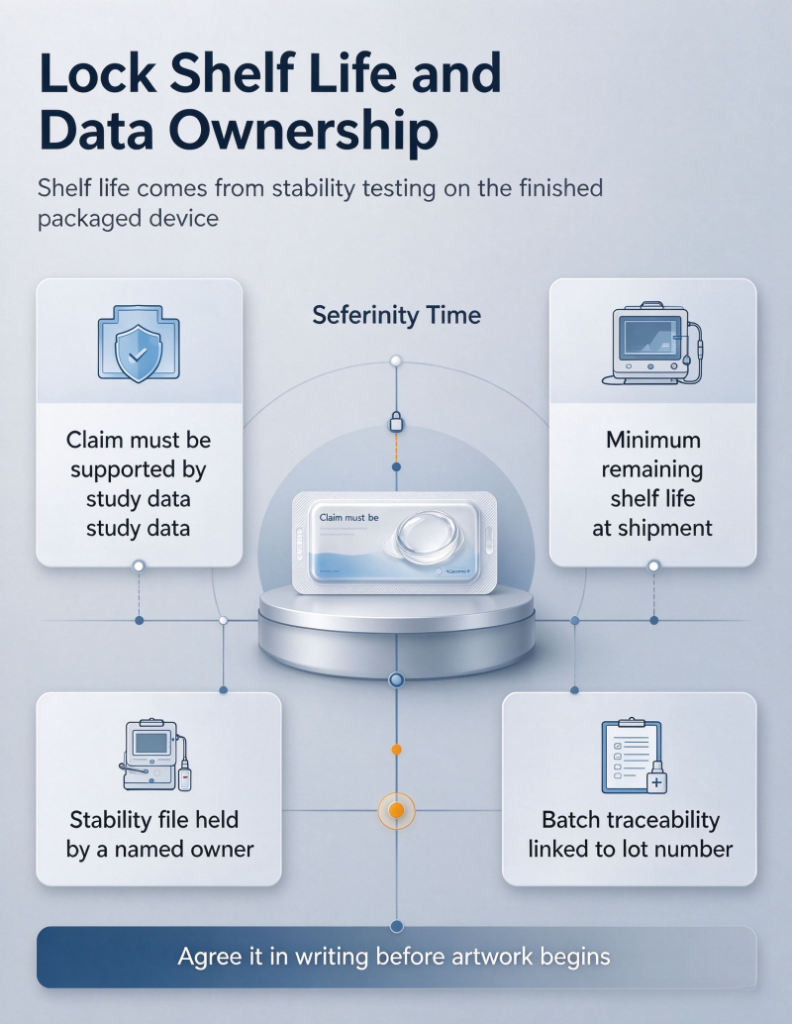
Shelf life comes from stability data generated on the finished, packaged device — the lens in its blister, in its carton, under defined conditions. It is not a category convention and it is not a number that can be inherited from a similar product.
For a private label programme, agree in writing:
- the shelf life you are claiming, and the study that supports it;
- minimum remaining shelf life at shipment — the shortest life you will accept on arrival;
- what happens if a batch is shipped below that minimum;
- who holds the stability file, and whether you can obtain it if a market authority asks.
3. The IFU
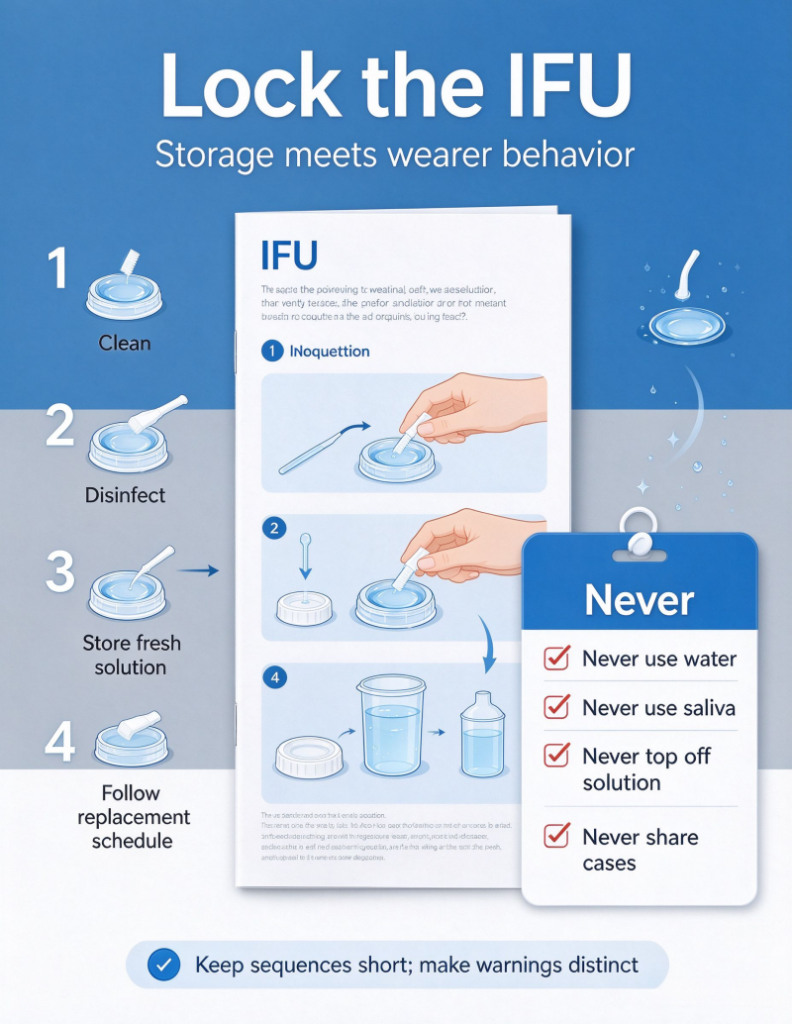
The instruction leaflet is where storage meets behaviour. At minimum it should cover cleaning and disinfection method, storage between wears, replacement schedule, what never to do (water, saliva, topping off solution, sharing cases), contraindications and the symptoms that mean "remove the lens and seek clinical care".
Two practical observations from supporting brand launches across markets: keep the cleaning instruction to a short numbered sequence, and keep the "never" list visually distinct. Wearers follow sequences; they skim paragraphs.
4. Claims discipline
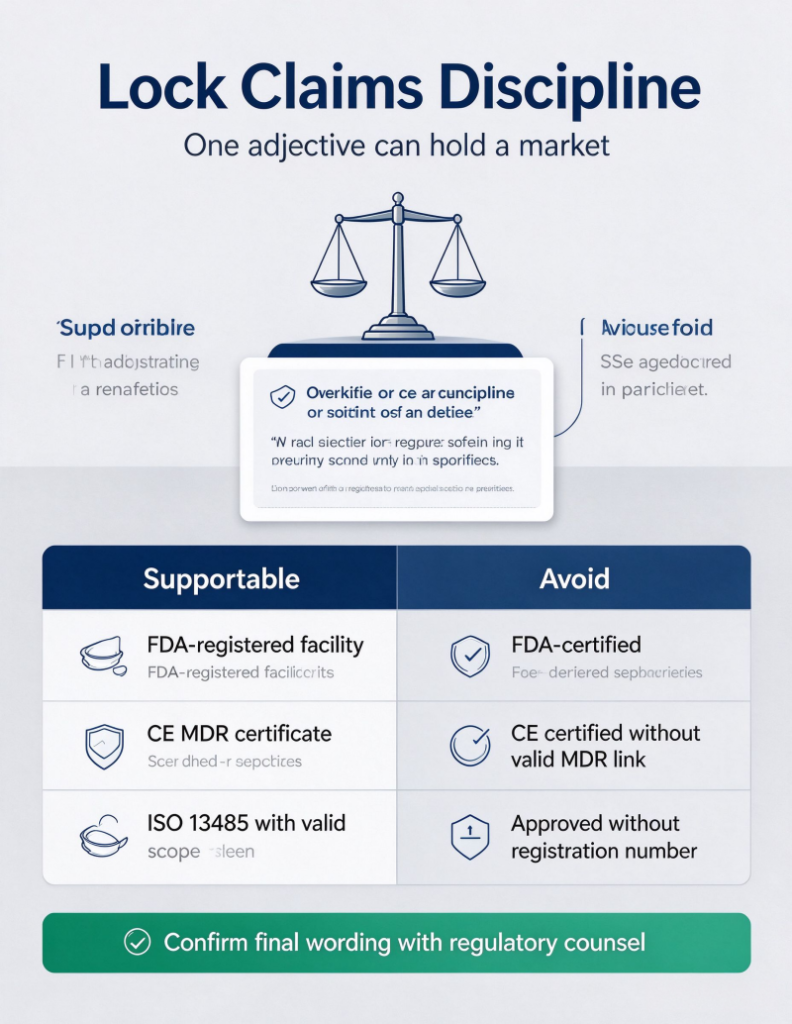
This is where launches most often stall, because a single adjective can hold up a market.
| Claim | Status | Notes |
|---|---|---|
| "FDA-registered facility" | Supportable if the site is registered and the device listed | Registration is a factual status you can evidence |
| "FDA-certified" | Avoid | FDA registers establishments and lists devices; it does not confer a "certified" status on a facility. Confirm wording with your regulatory counsel |
| "CE certified" | Only with a valid certificate referencing the applicable regulation | Check whether the certificate cites MDR; a certificate referencing superseded legislation is a different claim |
| "ISO 13485 certified" | Supportable with a current certificate and scope covering the site | Verify the scope names the actual manufacturing site |
| "Approved in [country]" | Only with the actual registration number | Keep the number on file and quotable |
Our own facility documentation is a useful reference point for how this is stated precisely: Gansu Constar Technology Group is listed with CE (MDR) and ISO 13485, while Hunan Haipuming Technology (Liangguo Group) is listed with ISO 13485 and FDA-registered status. The distinction matters because a buyer will check it.
Artwork checklist
Run this before the printer receives files, not after the proof arrives.
| Item | What to verify |
|---|---|
| Storage statement | Matches the technical file; consistent across carton, IFU and website |
| Expiry format | Unambiguous date format; no market-ambiguous numerals |
| Lot number | Present on foil and carton; traceable to batch record |
| UDI / regulatory identifiers | Present where the target market requires it |
| Manufacturer identification | Legal manufacturer name and address, not the brand owner's marketing address alone |
| Translated IFU | Translated by a qualified translator, reviewed by a native speaker with device familiarity — not machine translation |
| Symbols | Used per the applicable standard, with a legend where the market requires one |
| Contradictions check | Carton vs IFU vs website read side by side by one person |
That last row catches more defects than the other seven combined.
Multi-market realities
A single SKU sold into several markets needs a language matrix, not a single leaflet. Practical sequencing:
- Fix the source-language IFU first; freeze it.
- Translate from the frozen version, not from a moving draft.
- Register market by market — EUDAMED and SFDA pathways, for example, each require their own documentation set, and the same storage statement must appear in all of them.
- Version-control by market and by date; keep superseded versions retrievable.
If you sell in the EU, the regulation also expects a named person responsible for regulatory compliance to be in place before the product goes to market. Confirm the current requirement with your notified body rather than relying on secondary summaries.
Handover: what to demand from your OEM partner
A private label programme is only as strong as the documents that travel with it. Ask for, and keep in your own file:
- the storage statement in the exact wording printed on pack;
- the shelf-life study summary and the conditions tested;
- the site's current certificates, with scope and validity dates;
- the batch record reference format, so a lot number can be traced;
- a written statement of which claims the factory can evidence;
- the artwork approval record with sign-off names and dates.
If any of these arrives only as a verbal assurance, it will not survive a market authority's question — and it will not survive a customer's either.
We hold these as a single handover pack for brand partners, and the product catalogue behind it is available through our catalogs. Brands we manufacture for are listed under our brands, which is the shortest way to see how the same compliance framework adapts across distinct visual identities.
Frequently asked questions
Can I use the same storage statement as another brand's carton? No. The statement must describe your product's validated conditions and shelf life. Copied wording usually refers to a different blister, lens material or stability protocol.
How is contact lens shelf life determined? By stability testing on the finished, packaged device under defined conditions. It is not a category convention and cannot be inherited from a similar product. The resulting date is printed on the foil and carton.
Can I say my lenses are FDA certified? Use "FDA-registered facility" only if the site is registered and the device listed, and treat "FDA-certified" as unsupported — FDA registers establishments and lists devices rather than certifying them. Confirm final wording with your regulatory counsel.
Does the IFU need to include storage instructions? Yes. Storage between wears, cleaning and disinfection, the replacement schedule and the things the wearer must never do all belong in the instructions for use, and must not contradict the carton.
What is minimum remaining shelf life and should it be in the contract? It is the shortest remaining shelf life you will accept at delivery. Put it in the purchase order: it is the only practical protection against receiving stock with most of its life already consumed.
Who is the legal manufacturer on a private label pack? The entity that takes responsibility for the device — usually the factory or the brand owner depending on the regulatory arrangement in that market. Settle this in writing before artwork is generated, because it determines the address printed on the carton.
Do I need a separate IFU per language? Yes, per market language, translated from a frozen source version by a qualified translator and reviewed by a native speaker familiar with medical devices.
How often should the artwork be reviewed? At every change of supplier, material, shelf life, registration status or applicable regulation — and on a fixed periodic cycle even when nothing appears to have changed.
- FDA, 《Contact Lens Risks》— https://www.fda.gov/medical-devices/contact-lenses/contact-lens-risks
- CDC, 《 Preventing Eye Infections When Wearing Contacts》— https://www.cdc.gov/contact-lenses/prevention/index.html